Monday, July 25, 2011

Australia may be a Nuclear Target - Summary

1. Foreign Minister - this entails representing Australia abroad (occasionally) and looking after matters related to foreign affairs
2. That Australia may become a target of the products of the North Korean long range missile program
3. The ASEAN Regional Forum
4. North Korea has been involved in several military gaffes lately involving shell fire and weapons testing over the border into South Korea
5. North Korea's missile testing and capabilities
6. Rudd is trying to achieve status and get attention for what he believes is a problem, and wants to consolidate ties with the rest of the region
7. Although ties with the US may be as strong as ever, it could be said that ties will not make much of a change for the better

Sunday, July 24, 2011

Foreign Aid Review - Summary

From Hugh White's article on the levels of aid given by Australia (written on 19 July), we can discern that White opines:

- This country spends too much on aid

- Aid that has been given has varying amounts of effectivity

- Poverty, although reduced, is still rife (1000000000 people earning <$1.25 a day)

- The World Bank predicts further decline in poverty numbers

- The primary reason of growth in Third World nations is not aid intake but economic growth

It is my belief that Australia is contributing more aid as a result of either pressure from other parts of the First World or guilt permeated by publications (often from the UN) on increasing poverty. It needs to be understood that while aid may give immediate help, growth is the primary reason of recovery economically - White is completely correct in this respect. His statement on the dwindling power of the West is provocative (and maybe slightly brash) but raises an interesting point - this article provides very interesting commentary and raises a good point - perhaps poverty (like many other problems that affect the world) has solutions beyond continual spending.

Thursday, April 28, 2011

Hong Kong in Five Images/五香港圖片

Hong Kong Island, the Kowloon Peninsula and the New Territories make up the city of Hong Kong, located in Southern China with a population of about 7000000 people and one of the world's highest population densities. Hong Kong was a British colony from 1842 to 1997 (with a brief period of Japanese occupation from 1941-1945), when it joined Mainland China as a Special Administrative Region (SAR) in the People's Republic of China, meaning it has more economic and political freedom than other parts of China (excluding Macau, the other SAR). Hong Kong's population is 95% Chinese - the people of Hong Kong speak Cantonese and write in Traditional Chinese script. Hong Kong enjoys one of the highest standards of living in the world. Below are five images of what makes Hong Kong unique.

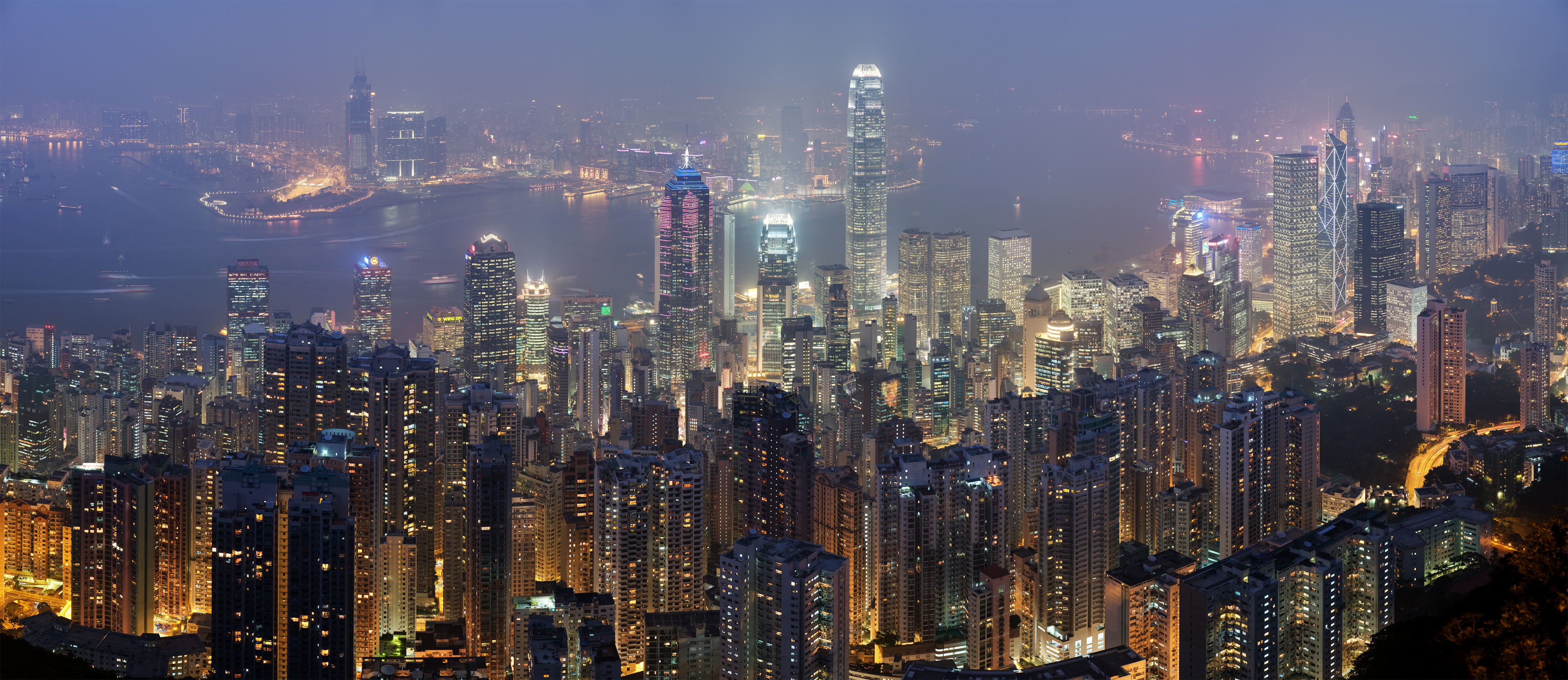
Hong Kong has an iconic skyline. The astronomical level of population density and the relative lack of  space to accommodate it has led to a need for immense urban consolidation, making Hong Kong the world's most vertical city. Hong Kong's economy has become one of the world's greatest and the skyscrapers, often a sign of commercial success, are a prime example of this. The above picture is of the view from Victoria Peak, the highest mountain on Hong Kong Island.

The lack of space in Hong Kong has led to extremely expensive real estate, thus the vast majority of people live in apartments in high-rise housing estates such as this one. People living in such apartments often have access to many amenities, as many estates include a shopping complex or a market. Such establishments are the norm in Hong Kong and only the very wealthy have large, detached homes. The above picture is of a private housing estate, Hong Kong Parkview.

Hong Kong is highly commercialised, with a very technologised population. Shopping is very diverse and popular, with many large-scale shopping malls and upmarket stores. Statistics such as the fact Hong Kong has more mobile phones per capita than anywhere else in the world, or the fact that there are more Mercedes-Benz in Hong Kong than there are in Germany itself demonstrate how commercial Hong Kong has become. The above picture is of Tong Lau, traditional shophouses and still a common sight.


90% of Hong Kong's residents practice a mix of local religions. The mixture of old and new is prevalent in Hong Kong, with many locals maintaining belief in Confucian concepts of harmony, Taoist traditions of ancestor worship and countless cultural superstitions, such as the architectural philosophies of Feng Shui (meant to bring harmony into a structure or space through nuances such as building features or furniture placement). The above picture is of a Tin Hau Temple in Causeway Bay, a declared monument.

 Stilt houses, known as Pang Uk, provide a disappearing window into what Hong Kong may have looked like centuries ago as a collection of fishing villages. A fire in 1953 in the Shek Kip Mei area destroyed the shanty (slum) homes of 53000 people. This later prompted the response of creating a public housing scheme to house lower-class communities in the city, which has succeeded dramatically. A fire 11 years ago destroyed 2000 of these stilt houses. The above picture is of the few remaining, in the Tai O area.

In conclusion, the eclectic mixture of old and new, East and West is what makes Hong Kong a truly unique city to live in, and, although possessing one of the world's highest qualities of life and being one of the world's most modern cities, a city constantly making efforts to preserve a millenia-old culture and its traditions.

Monday, March 7, 2011

The Science of Big Waves

Pre-viewing:
1. Where do ocean waves come from? What gets them started? 
        Ocean waves come from the 'wave factory' in the Pacific Ocean. When the high and low pressure systems meet, pressure is released from the air and pushed right into the water.
2.  What do you think a surfer should know about waves before they try and ride a wave while surfing? 
Where they break, when they break how they break. How best to exit the wave if you need to.

Questions for the Video

1. Observe all the waves that you see and describe how they form and break. Use as many words found in the segment for you descriptions. 
  The steep reef, headland, pressure systems, wind and fetch all come into play to form the Maverick waves.
2. Describe how waves are formed, how they originate, and how they are measured? 
They start thousands of miles away in a place called the 'wave factory' in the Pacific, the low pressure system meets the high pressure system and the energy is transferred from the air to the water. Windspeed (60 km/h), fetch (2000 miles) and duration (4days) .
They are measured in three waves; height, period and wave length (peak to peak or trough to trough). The longer wave length, the longer the period between waves.
3. What is a maverick wave and what is special about the way it is formed?
Some of the biggest in the world. the "mount everest of surfing". The sharp ocean floor converts the potential energy into kinetic energy. The wave refraction causes the wave to bend and rise and it feeds the energy to form the perfect wave.
 
4. How is energy stored and transferred during wave  
The enrgy rotates the water, and that energy is used to propel the wave.
5. List any kind of advice given by the surfers about how to survive these “big waves.” 
"The trick is to get in there and steal some fire before the full wrath of the wave is unleashed".
Sufers need to respect the full power of these waves as it could quickly turn into a fight for survival.

Big waves - The Cribbar


The Cribbar (English: Ploughed Reef), also known as the Widow Maker, is a reef off the Towan Headland in Newquay, Cornwall, United Kingdom.
The Cribbar is best known for creating annual big waves, popular with experienced big wave surfers from across the world. Wave faces can be in excess of 30-40ft. The Zorba is a reef 2 miles further off the coast and creates waves of 50ft or more.
File:Cornwall UK location map.svgThe Cribbar's location in Cornwall, England

Tweed River Entrance Sand Bypassing Project Questions


1.  Offshore sand bars were beginning to form and they were a hazard to the ships that were offloading or onloading their cargo at Tweed River. The easiest solution was to build a breakwater.
2. The natural transportation of sand up the coast towards the Gold Coast was cut off as the sand stopped moving and built up at the Breakwaters.
3. Longshore drift moved sand up the coast North towards the Gold Coast, meaning sand build up across the mouth of the river. This then beacme a hazard for ships trying to travel up the river as they could become stuck or damaged by the sand bars.
4. It was a short-term solution only as the process was expensive and innefficient.
5. Pipelines underground pump the sand from where it accumulates to the beaches that are lacking sand on the Gold Coast
6. This project has been regarded as one of the most successful coastal management strategies implemented in Australia because it is so efficient and subtle. I think the process is really clever and there is no better solution to such a situation. The dredging of the sand was both expensive and environmentally unfriendly whereas the pipeline is very efficient and inexpensive (in comparison to the dredging).
7. 

8. The beach has become more square and the is more sand has built up around the recently built Breakwater.
9. 
500m

Summarisung the TRESB Project

1. The problem that led to the TRESBP was that longshore drift moved sand (that was moving North) across the mouth of the Tweed River, this then put boats and ships moving into the river at risk as the offshore sand bar could damage them.
2. There was one unsuccessful solution - they updated it and now the solution is considered one of the greatest  management strategies introduced. The first solution was the dredging and transport of the built-up sand north towards the Gold Coast, this was expensive and environmentally unfriendly so there was a need to update and improve the strategy. The new strategy was then to build underground pipelines that pumped the built-up sand north to the beaches that have been deprived of sand.
3. 
The result of the project was the beaches were replenished with sand - the TRESB was a success